


Kitter Keep
Known for the pink, sweet-smelling mist that surrounds them, foggy willows thrive in high temperature climates. Many love the foggy willow for its leaves, whose softness is like that of a combination of hay and a cat’s tail. Because of their firm softness, the leaves are often used as cheap filling for beds and thick blankets. Others enjoy placing these trees in their gardens to fill the air with a sweet, fresh smell.
However, the primary resource of the foggy willow is found within the tree. The hollow trunks contain small, sticky, vein-like tubes that hold watery sap. This delicious sap, known for its rather surprisingly bittersweet aftertaste, is prized as a treat by Kitters and Meeps alike. There are many other purposes that this sap can be used for, including perfume and natural medicine.
Addendum by Nimby the Herbalist: Odoraphyllus Salix, known commonly as the foggy willow, is a desert variety of the misty oak. The dull red color of the tree’s leaves is due to the high concentration of anthocyanin in the plant. It is believed that this prevents overexposure from the sun considering the low rainfall of the regions it inhabits.
Unbeknownst to most Kitters, the foggy willow is one of the few carnivorous plants on the continent of Ostaria.
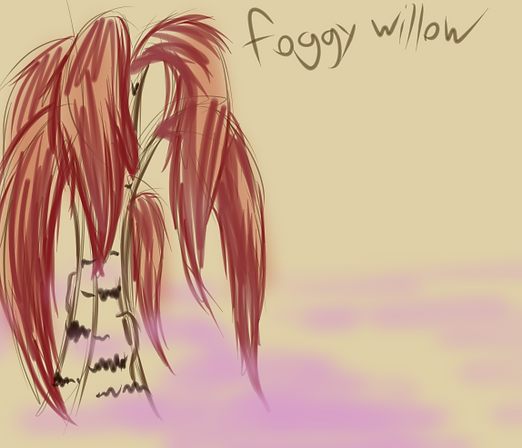
The odd pink mist that surrounds the foggy willow is a result of its sap evaporating from extreme heat. Because of the dry soil of the regions these plants come from, the foggy willow has adapted by using its sap to lure small insects into its hollow trunk. Insects are drawn by the sweet mist and enter one of the numerous holes scattered across the tree’s body. Once they step inside, they get trapped on the sticky sap veins and are slowly digested by the tree.
Although there have been rare reports of small mammals and birds being found in these trees, Kitters need not worry about being eaten, as these holes are rarely larger than a golf ball. Should they stick their paw inside, they’ll find that the sap’s stickiness cannot hold even a young Meep. The result would simply be the vein breaking and the Kitter being stuck with a sticky hand until they can wash up.
The foggy willow is just one tree in the misty oak family. Related varieties of different colors, shapes, and sizes that dwell in colder and more humid climates exist. These include the fluffy willow, vapor willow, steam sallow, and of course, the sweet scent tree.
Illustration from Hekate's research notebook
One of the most common flowers on Ostaria, the Prisma flower is known for producing the nectar used by Alge to create Elly. This flower can found nearly anywhere, including high on the rocky cliffs of Mount Highstone, deep in the marshy wetlands of the Dead Swamp, enduring under the scorching heat of Charfire Desert, and many more places. To survive the varying conditions found in these areas, the Prisma has developed the power to adapt new elemental properties to ensure its own survival. This ability, known as the Prism Effect, changes the color on a Prisma’s petals and affects the type of Elly that Alge create from its nectar. There are six types of Prismas, each corresponding with one of the six original elements.
Blazing Prisma: Found in the Charfire Desert, this flower is fireproof and absorbs sunlight to survive. It has red petals and produces Ember Elly.
Ocean Prisma: Located in swamps and besides lakes, rivers, and oceans, this flower is unaffected by waves or rainstorms that may come its way. It has blue petals and produces Ocean Elly.
Gusty Prisma: Often found growing besides Breezeberries in high altitudes, such as on the cliffs of Mount Highstone, the Gusty Prisma has strong roots that allow it to endure a gale-force wind. It has green petals and produces Breezy Elly.
Pebble Prisma: Found in rocky caverns, the Pebble Prisma has extremely durable petals that can survive being crushed by a boulder. It has tan petals and produces Rocky Elly.
Dawn Prisma: Usually found in extremely sunny areas, this flower can create a tiny forcefield around itself if something threatens to disturb it. This forcefield, though weak enough to be shattered with a single blow, is enough to startle some animals into not eating it. It has bright yellow petals and produces Bright Elly.
Dusk Prisma: Located in extremely dark areas, this flower requires no sunlight to live. It can bend shadows to darken the region it’s in, making it harder for animals to find and eat it. It has dark purple petals and produces Night Elly.
Prisma
